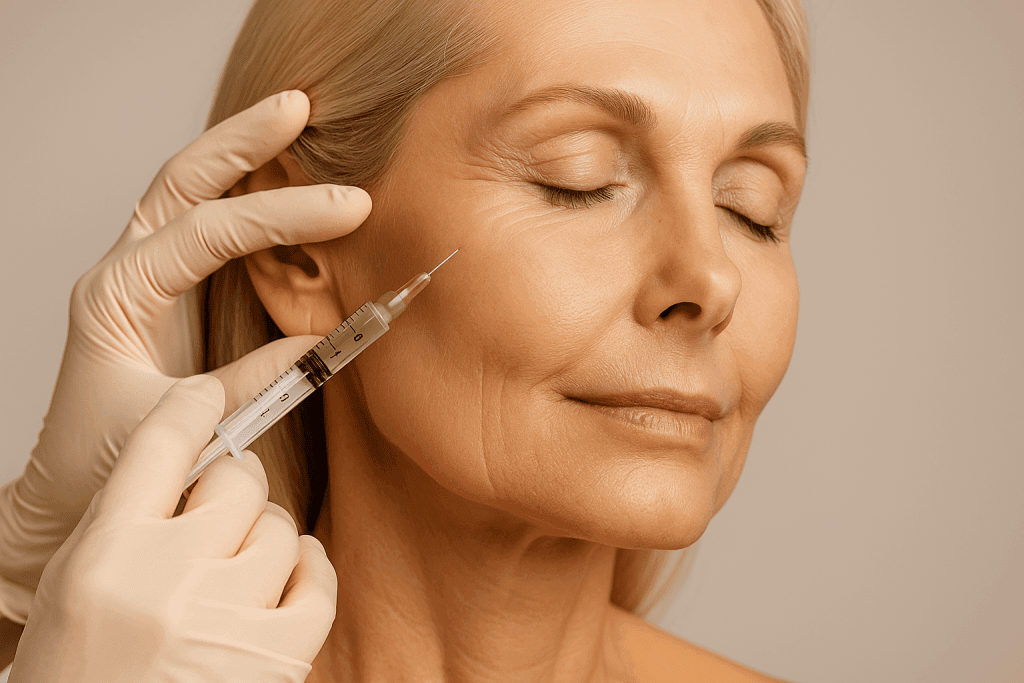
As we age, the aging process causes changes that impact human biological function and structure. One visible change is skin aging, characterized by reduced facial elasticity, resulting in a sagging or tired appearance. In the modern world of health and aesthetics, fillers have become a widely used approach to restore this condition without invasive surgical procedures. Fillers consist of various compositions of ingredients tailored to the needs and goals of the therapy, whether to maintain skin health or to add volume to specific areas of the face. [1]. One of the most common materials used as a filler is hyaluronic acid. This substance plays a vital role in maintaining skin hydration and elasticity, as well as helping improve facial contours. Furthermore, hyaluronic acid is also known to have the potential to support wound healing and reduce pain in certain conditions. [2].
Along with advances in biomedical technology, stem cell-based approaches are beginning to be developed in the fields of facial aesthetics and reconstruction. In practice, stem cells do not act as fillers that directly provide volume, but rather can support regenerative processes and regulate biological responses in the tissue microenvironment. [3,4]. These stem cells can be combined with other materials filler seperti asam hialuronat atau fat graft.
The application of stem cells and their derivatives as fillers has the potential to provide longer-lasting results, is safer due to the minimal risk of allergies or biological rejection, and provides more natural results. [5]. Through the paracrine effect of stem cells through the secretion of various bioactive molecules that work on the surrounding cells and tissues, there will be modulation of the tissue microenvironment,This ultimately promotes regeneration, repairs skin structure, and improves overall skin quality. This paracrine effect then triggers various interacting biological mechanisms, including:
- Formation of New Blood Vessels (Angiogenesis)
Secretion of growth factors such as vascular growth endothelial growth factor (VEGF). This increased vascularization is important for improving oxygen and nutrient supply, supporting the integration of filler materials, and increasing cell viability in combination procedures such as fat grafting. Optimal vascularization contributes to long-term stability of results.[6].
- Maintaining Immune System Balance (Immunomodulation)
Stem cells have the ability to regulate local immune responses by modulating the activity of macrophages, lymphocytes, and other immune cells, thereby supporting the tissue healing process and potentially reducing the risk of complications.[6].
- Stimulates Skin Tissue Repair
Bioactive factors secreted by stem cells stimulate the proliferation and activity of skin fibroblasts. This increases the synthesis of collagen, elastin, and other extracellular matrix components, thereby repairing skin structures degraded by aging. This contributes to more natural-looking filler results.
Currently, the provision of stem cell therapy services in reconstructive and aesthetic plastic surgery cases, including in the context of filler procedures telah memiliki landasan hukum berdasarkan Decree of the Minister of Health of the Republic of Indonesia Number HK.01.07/MENKES/1200/2025 concerning Guidelines for the Implementation of Cell and/or Stem Cell Therapy Services in the Field of Reconstructive and Aesthetic Plastic Surgery.
In line with these regulations, ProSTEM provides high-quality stem cells produced in facilities certified by Good Manufacturing Practices (GMP) and licensed by the Ministry of Health of the Republic of Indonesia. This demonstrates ProSTEM's full dedication to maintaining quality and safety standards. We ensure that every therapy service provided is safe, effective, and complies with medical regulations for patient safety. For more information regarding stem cell therapy services related to filler injections, please contact us via WhatsApp on this website.
References
- Liu, J., Gao, M., Hu, H., Pang, H., Liu, Y., & Zhang, P. (2025). Facial injectable Fillers in Aesthetic Medicine: clinical applications and safety strategies. Medical Science Monitor, 31, e949944. https://doi.org/10.12659/msm.949944
- Hong, G., Wan, J., Park, Y., Yoo, J., Cartier, H., Garson, S., Haykal, D., & Yi, K. (2024). Manufacturing process of hyaluronic acid dermal fillers. Polymers, 16(19), 2739. https://doi.org/10.3390/polym16192739
- Zheng, J., Park, K., Jang, J., Son, D., Park, J., Kim, J., Yoo, J., You, S., & Kim, I. (2024). Utilizing stem cell-secreted molecules as a versatile toolbox for skin regenerative medicine. Journal of Controlled Release, 370, 583–599. https://doi.org/10.1016/j.jconrel.2024.05.009
- Machado, J. J. D. S., Piñeiro, B. G., Ramos, I. P., De Souza, S. a. L., Gutfilen, B., Nicola, M. H., De Souza, P. R. C., Cruz, E., & Goldenberg, R. C. (2020). Safety and Localization of Mesenchymal Stromal Cells Derived from Human Adipose Tissue-Associated Hyaluronic Acid: A Preclinical Study. Stem Cells International, 2020, 1–15. https://doi.org/10.1155/2020/1823427
- Tovar, J. S., & Sandoval, J. L. F. (2026). SECRETOME-Assisted Regenerative Therapy for Hyaluronic Acid Filler-Induced Vascular Occlusion: a case report. Cureus, 18(1), e101978. https://doi.org/10.7759/cureus.101978
- Crowley, J. S., Liu, A., & Dobke, M. (2021). Regenerative and stem cell-based techniques for facial rejuvenation. Experimental Biology and Medicine, 246(16), 1829–1837. https://doi.org/10.1177/15353702211020701