
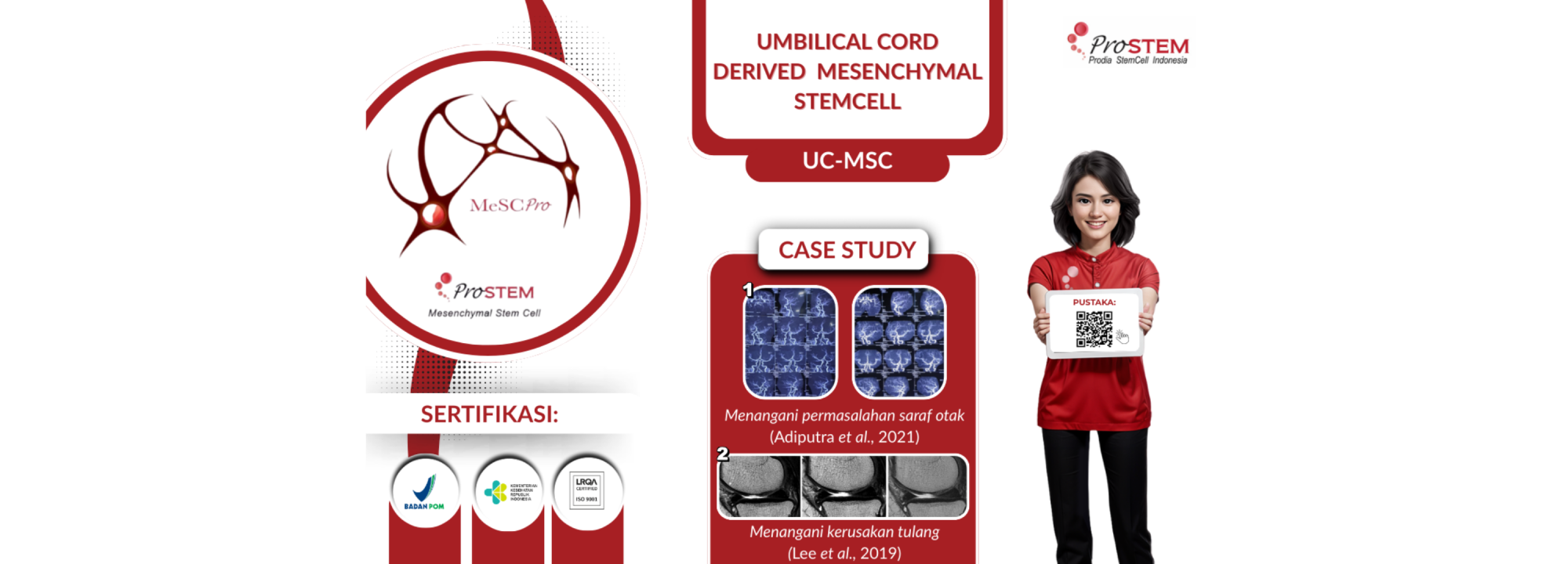
Mesenchymal Stem Cells ProSTEM (MeSCPro) is the result of processing Mesenchymal Stem Cells (MSCs) derived from the umbilical cord (UC) , which possess the ability to self-renew and secrete bioactive compounds(self-renew) and produce bioactive compounds with immunomodulatory properties. MeSCPro produces molecules that have antimicrobial and antiviral activity, as well as the potential to provide analgesic effects. MSCs offer various advantages in improving physical health, reducing inflammation, and helping to treat various degenerative and other diseases. [1]
To meet the increasing demand for Mesenchymal Stem Cells (MSCs)ProSTEM continues to expand its capacity to produce MeSCPro from various sources. However, MSCs derived from umbilical cords have a key advantage as they are obtained at an early stage of development with minimal environmental exposure. All processing and storage procedures adhere to BPOM standards, ISO 9001:2015, and Indonesian Ministry of Health Regulations No. 48 and 50 of 2012, ensuring ProSTEM's commitment to maintaining the quality of every MeSCPro processed and stored.
Benefits:
- MSCs can be used to treat degenerative diseases such as myocardial infarction[2], osteoartritis[3], stroke[4], wound healing[5], dan lainnya.
- MSCs can help maintain physical and cognitive function as we age.
- MSCs provide various benefits to physical parameters, inflammatory biomarker, endothelial function, and many other aspects of health.[6]
- MSCs produce molecules with properties antimicrobial and antivirus, and can help reduce pain.[6]
- MSCs can increase the phagocytic capacity of M1 macrophages (pro-inflammatory) and directing the shift towards M2 phenotype (anti-inflammatory).[7]
References
- Caplan, A.I (2017). Mesenchymal Stem Cells: Time to Change the Name!. Stem Cells Translational Medicine, 6: 1445–1451.
Hare JM, Traverse JH, Henry TD, Dib N, Strumpf RK, Schulman SP, et al (2009). A randomized, double-blind, placebo-controlled, dose-escalation study of intravenous adult human mesenchymal stem cells (prochymal) after acute myocardial infarction. J Am Coll Cardiol, 54:2277–86. - Matas, J., Orrego, M., Amenabar, D., Infante C., Limonchi R., Cadiz MI., et al (2018). Umbilical Cord-Derived Mesenchymal Stromal Cells (MSCs) for Knee Osteoarthritis: Repeated MSC Dosing Is Superior to a Single MSC Dose and to Hyaluronic Acid in a Controlled Randomized Phase I/II Trial. Stem Cells Translational Medicine, 8:215–224.
- Wang, F., Tang, H., Zhu, J., Zhang, J (2018). Transplanting Mesenchymal Stem Cells for Treatment of Ischemic Stroke. Cell Transplantation, 27(12): 1825–1834.
- Lam PK, Lo W., Tong, CW., Lo KY., Chook P., Lai P, et al (2018). Topical Application of Adipose-Derived Mesenchymal Stem Cells in the Treatment of a Non-Healing Ulcer in a Leper: A Case Report. World Journal of Surgery and Surgical Research – Surgery, 1(1016).
- Schulman, IH., Balkan, W., Hare, JM (2018). Mesenchymal Stem Cell Therapy for Aging Frailty. Frontiers in Nutrition, 5(108).